


- サイズなし In stock
商品番号: 17-1156-140
Ame Nimo Makezu
Ame Nimo Makezu
Couldn't load pickup availability
Add to cart
1 colors in total
Add to favorites
 no color
-
¥1,980
In stock
商品概要
商品概要
A notebook left behind by Kenji.
The words contained within continue to touch the hearts of many people.
The words that Kenji wrote down during his battle with illness were not written as a piece of work, but were Kenji's prayers themselves.
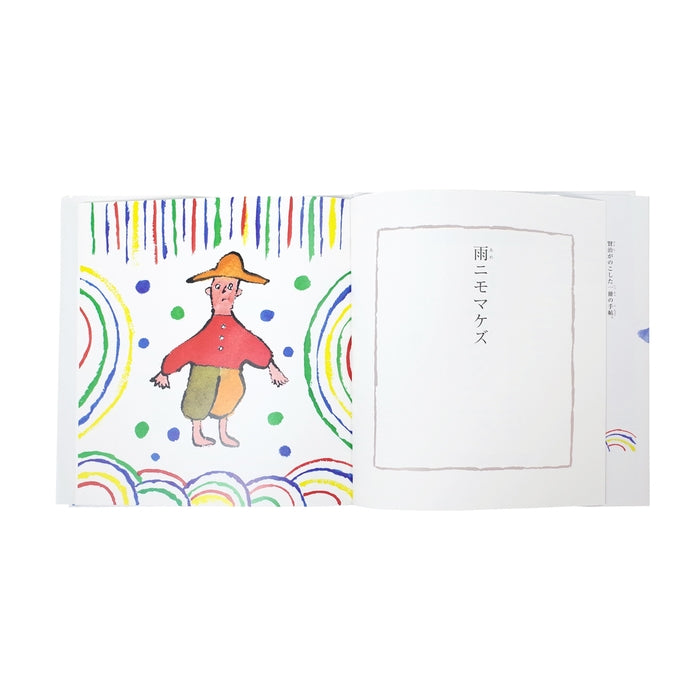
``I'm thinking of painting this ``Ame Nimo Makezu'' brightly.''
This is a work that Sayaro Yuzuki put all his heart and soul into as he sat face to face with ``Ame Nimo Makezu'' and looked deeply into it!
In order to make the paintings more approachable, they are not too abstract, and I want to emphasize what you can feel from the paintings.
*At the end of the book, there is an essay by Kazuki Miyazawa, Kenji's younger brother and Seiroku's grandson, and an image of the "Ame Nimo Makezu" notebook.
Yunoki Samiro
Born in Tokyo in 1922.
After the war, he worked at the Ohara Museum of Art in Kurashiki. There, he encountered the Mingei movement, studied under Serizawa_suke, and started dyeing patterns. In addition to stencil dyeing, he has also tried various works such as prints and glass paintings, and is active in a wide range of genres.
In 1958, the pattern-dyed wallpaper won a bronze medal at the Brussels World's Fair in Belgium. In 1990, he won the first Kenji Miyazawa Award for Kenji Tokei (Yobisha).
Not only in Japan, he has also held solo exhibitions in Paris since 2008. In 2015, many of his works were acquired by the French National Museum of Oriental Guimet.
In 1996, he won the Children's Space International Book Award for his first picture book, ``Magic Words'' (Eskimo Words: Translated by Hisao Kanaseki, Craft Space). The book was published by Fukuinkan Shoten in 2000. Received the ``Sankei Children's Publishing Culture Award Art Award'' for ``Sennen Mannen'' (Mado Michio/Poetry Rironsha).
His other picture books include ``Toko, Goo Goo and Kiki'' (written by Ado Murayama, published by Fukuinkan Shoten), ``Tsukiyo no Ongakukai'', ``Sotara, Sotara'' (all published by Fukuinkan Shoten), ``Pheasant Wife'' (written by Ado Murayama, published by Bunka Publishing Bureau), and ``Zetsubou no Dakuten'' (written by Munenori Harada, Kyoiku Gageki).
Received the Mainichi Design Award at the ``Yuzuki Sayaro life・LIFE'' exhibition held from 2021 to the following year.
●Art materials used: Transparent watercolor/Paper: Watercolor paper (Arche)
[Publication date] October 15, 2016


 MIKI HOUSEOfficial Instagram


